
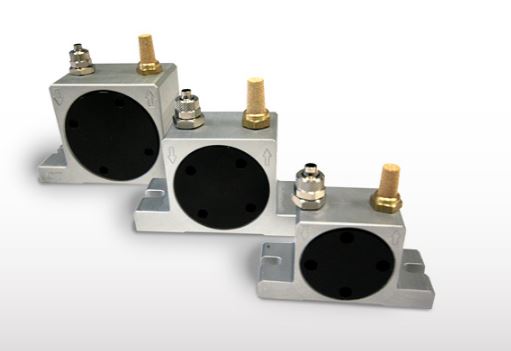
 Pneumatic Turbine Vibrators for Hoppers, Chutes, Screens and Vibrating Tables
Filquip supplies OLI OT series pneumatic turbine vibrators. A turbine vibrator uses compressed air to spin an internal turbine fitted with an eccentric mass, producing high frequency rotary vibration. Because the vibrator runs on compressed air alone, no electrical supply is required at the point of installation.
The vibration frequency and centrifugal force are adjusted by the air pressure supplied to the vibrator, from 2 bar to 6 bar. This makes the turbine vibrator a simple way to fine-tune vibration on site using a flow control valve or regulator.
 Typical Applications
The OLI OT turbine vibrator datasheet lists the following applications:
- Hoppers and silos, to reduce friction between the material and the vessel wall.
- Screens and vibrating tables, for separation.
- Chutes carrying dry and granular materials, including food products.
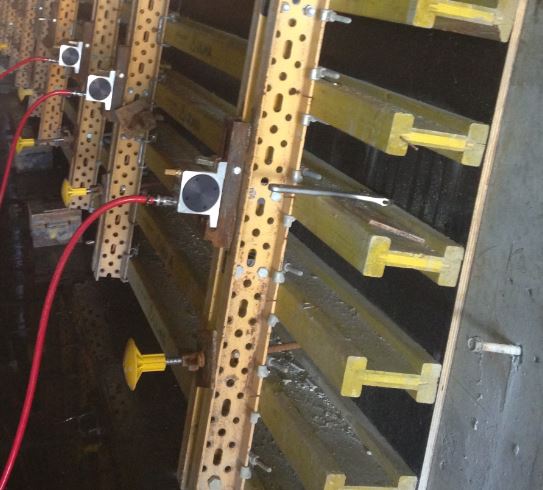
- Concrete consolidation.
OLI OT Turbine Vibrator Features
- Continuous duty cycle.
- Working pressure from 2 bar to 6 bar (29 psi to 87 psi).
- Working temperature from -20°C to 120°C.
- Maximum noise level below 90 dB(A).
- Aluminium body.
- ATEX II 2D CT(X) / II 2G CT(X), as stated on the OLI OT datasheet.
- Recommended air circuit: filter, flow control valve, lubricator and 3/2 way valve. Air supply quality Class 5.4.1.
- “S” models (for example OT36S) run at a lower vibration frequency than the standard model of the same size. See below for why this matters.
Standard and “S” Models: Frequency and Amplitude
The OT10, OT16, OT25 and OT36 are also available as lower frequency “S” models. At 6 bar the OT36S runs at 8,500 vpm compared with 12,000 vpm for the OT36, while producing a similar centrifugal force (754 kg and 749 kg).
For the same centrifugal force, a vibrator running at a lower frequency moves the vessel wall through a larger amplitude, so each vibration cycle is a bigger, slower movement. A higher frequency gives a smaller, faster movement. As a general guide:
- Standard models (higher frequency, smaller amplitude) generally suit fine, dry and free-flowing powders, screens and lighter-gauge equipment.
- “S” models (lower frequency, larger amplitude) generally suit coarser, heavier, granular or slightly damp materials, and heavier vessels where a larger movement is needed to break material away from the wall.
The right choice depends on the material, the vessel and how it is mounted. Our team can recommend a model from your Vibrator Sizing Form.
OLI OT Turbine Vibrator Models
The table below shows each OT model at 6 bar working pressure. Lower working pressures give lower frequency, force and air consumption. Full figures at 2, 4 and 6 bar are in the OT datasheet.
| Model | Part Number | Vibration at 6 bar (vpm) | Centrifugal Force at 6 bar (kg) | Air Consumption at 6 bar (l/min) | Air Inlet / Outlet | Weight (kg) |
|---|---|---|---|---|---|---|
| OT8 | EPT08 | 42,000 | 292 | 110 | 1/8″ BSP | 0.25 |
| OT10 | EPT010 | 38,000 | 252 | 110 | 1/8″ BSP | 0.26 |
| OT10S | EPT010S | 26,000 | 187 | 110 | 1/8″ BSP | 0.26 |
| OT13 | EPT013 | 31,000 | 300 | 285 | 1/4″ BSP | 0.57 |
| OT16 | EPT016 | 21,000 | 264 | 285 | 1/4″ BSP | 0.58 |
| OT16S | EPT016S | 17,500 | 234 | 285 | 1/4″ BSP | 0.61 |
| OT20 | EPT020 | 23,000 | 526 | 452 | 1/4″ BSP | 1.09 |
| OT25 | EPT025 | 17,000 | 508 | 452 | 1/4″ BSP | 1.12 |
| OT25S | EPT025S | 13,500 | 483 | 452 | 1/4″ BSP | 1.20 |
| OT30 | EPT030 | 14,500 | 781 | 749 | 3/8″ BSP | 2.20 |
| OT36 | EPT036 | 12,000 | 749 | 749 | 3/8″ BSP | 2.30 |
| OT36S | EPT036S | 8,500 | 754 | 749 | 3/8″ BSP | 2.53 |
View OLI OT Pneumatic Vibrators Open OT Turbine Vibrator Datasheet
Other Rotary Pneumatic Vibrators
Filquip also supplies OLI S series ball vibrators and OR series roller vibrators, which also run from 2 to 6 bar. For linear vibration, see the K series and F series piston vibrators. To run several vibrators from one air supply, see our Flow Aid Compressed Air Distribution Manifold.
Enquire About Pneumatic Turbine Vibrators
Filquip has been trading since 1999 and is an agent for OLI vibrators, with one team covering design, supply, installation and service. To help us select the right turbine vibrator, please send us the material being handled, the size and wall thickness of the hopper, chute or table, and the compressed air supply available on site. You can also complete our Vibrator Sizing Form.
Contact us on (07) 3208 3499 or email sales@filquip.com.au.